May 18, 2026 • 7 min read· Updated May 18, 2026
AI Prototype to Production Without Rework
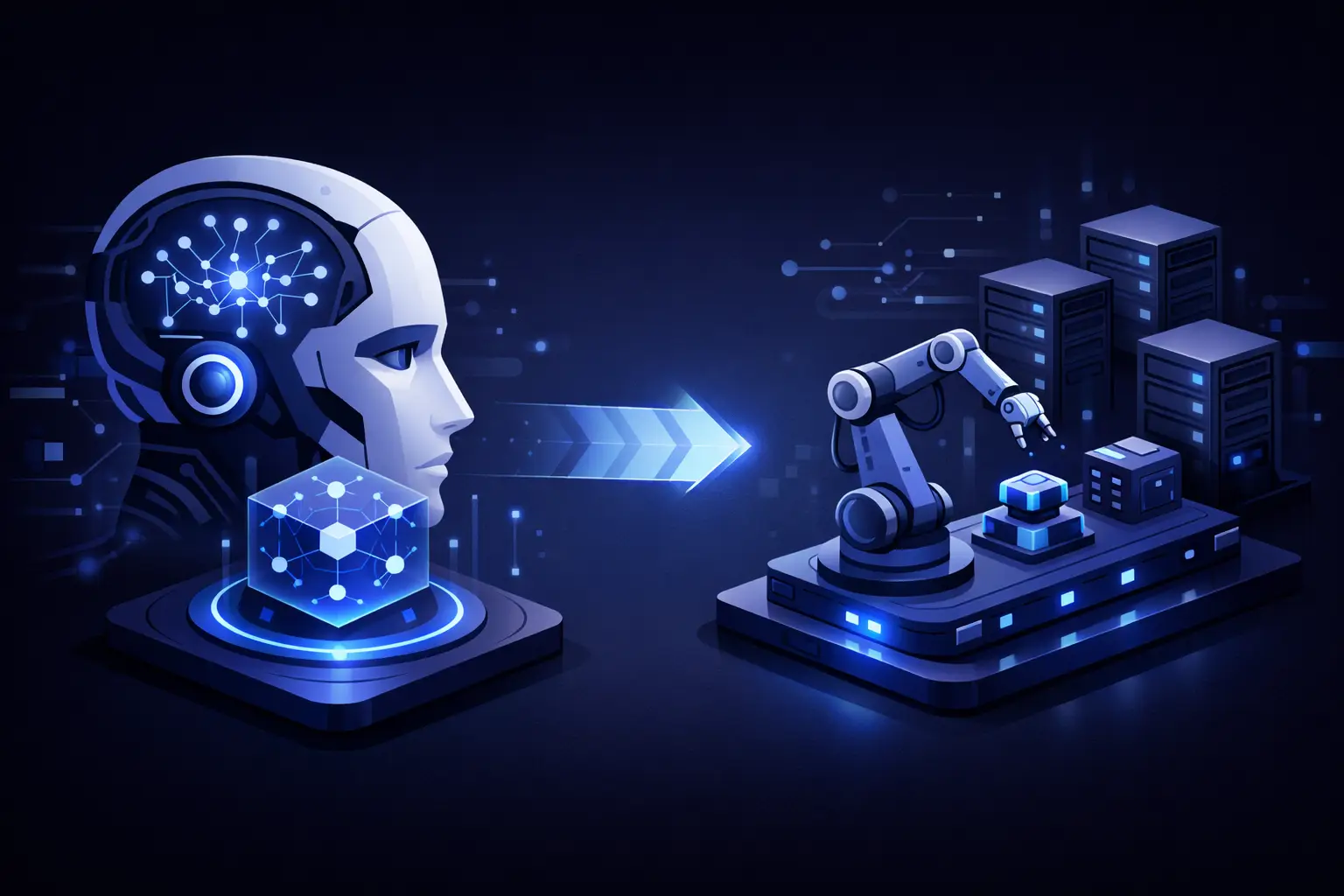
A demo that gets praise in a founder meeting can still fall apart the first week real users touch it. That gap between ai prototype to production is where most teams lose time, burn trust, and realize the model was the easy part.
The hard part is everything around it: data quality, failure handling, latency, observability, security, cost control, and product behavior under messy real-world usage. If you're a founder or product leader, this is usually the moment when an impressive proof of concept turns into a delivery problem.
Why ai prototype to production is where projects stall
Most AI prototypes are built to prove possibility. Production systems are built to survive repetition. Those are different jobs.
A prototype can rely on hand-cleaned inputs, a forgiving tester, and a few happy-path prompts. In production, users submit vague requests, edge cases pile up, upstream systems fail, and support tickets arrive fast. If the system has no guardrails, no visibility, and no fallback behavior, the team ends up patching symptoms instead of shipping a dependable product.
This is why many startups underestimate the transition. The prototype creates confidence because it works just enough to be persuasive. But once the AI feature needs to plug into authentication, billing logic, customer records, analytics, and actual workflows, the engineering scope changes completely.
The issue is not that the prototype was useless. The issue is treating it like a near-finished product when it's really a learning artifact.
The biggest mistake: building the demo like the final system
Founders often hear two bad extremes. One camp says to move fast and clean it up later. The other says to design a heavy enterprise-grade platform before demand is proven. Both can waste time.
A better path is to prototype for learning, then make a deliberate production pass once the use case is validated. That means preserving what's valuable from the prototype while being honest about what needs to be replaced.
In practice, the demo code often should not become the core production system. Sometimes parts of it survive, especially if the original build had strong engineering discipline. But many AI prototypes are held together by prompt experiments, thin backend logic, and assumptions that don't hold at scale. Carrying that forward usually creates more rework, not less.
What changes from prototype to production
The model decision matters, but it is rarely the only thing that matters. Production readiness usually comes down to the surrounding system.
Inputs stop being clean
Prototype inputs are often manually prepared or tested by the team that built the feature. Real users are inconsistent. They paste messy text, upload incomplete documents, ask broad questions, and trigger paths you did not expect. Your system needs validation, sanitization, rate limiting, and clear boundaries around what it can and cannot do.
Reliability becomes a product requirement
If the AI output is occasionally wrong in a prototype, the team shrugs and tweaks the prompt. In production, wrong answers can damage trust, trigger churn, or create operational risk. That means you need confidence thresholds, retry logic, fallback behavior, and in some cases human review paths. Not every feature needs the same standard, but every feature needs a defined failure strategy.
Latency and cost become visible
A prototype can tolerate slow responses if the result looks impressive. Users are less patient. If a feature takes too long, they abandon it. If usage grows and each request is expensive, margins tighten quickly. Going from ai prototype to production often requires prompt compression, caching, asynchronous workflows, model routing, and tighter control over when AI is actually invoked.
Observability is no longer optional
When a demo fails, the builder is usually right there watching it. In production, issues show up after release and under load. If you cannot inspect prompts, outputs, token usage, error rates, user paths, and external dependencies, debugging becomes guesswork. AI systems need the same operational visibility as the rest of your stack, plus model-specific tracing.
How to approach ai prototype to production without wasting months
The teams that do this well usually follow a simple principle: prove the product value first, then harden the delivery path with intent.
Start with the exact business job
Before architecture discussions get too abstract, define what the AI feature is supposed to do for the business. Save support time? Increase conversion? Reduce manual review? Improve onboarding speed?
This matters because production standards depend on business impact. An internal drafting assistant can tolerate more variance than an AI workflow that affects compliance or customer billing. If you skip this step, teams often overbuild low-value features and underbuild critical ones.
Define acceptable failure
Not every AI system needs perfect accuracy. But every system needs explicit rules for what happens when confidence is low or outputs are incomplete.
That might mean showing suggestions instead of auto-executing actions. It might mean escalating edge cases to human review. It might mean narrowing the scope so the model operates in a smaller, more reliable lane. Good production systems are designed around realistic failure, not wishful success rates.
Separate experimentation from production architecture
You want fast iteration on prompts, model choice, retrieval strategy, and workflow logic. You also want stable APIs, clean service boundaries, and maintainable infrastructure. Those goals can coexist if you separate the layers properly.
The product should not break every time the AI team tests a new prompt chain. Put experimentation behind controlled interfaces. Version prompts and workflows. Keep business logic outside the prompt when possible. This creates room to improve the AI layer without destabilizing the whole product.
Build for data reality, not pitch-deck data
A lot of AI demos are built against ideal sample data. Production systems live on fragmented records, inconsistent formatting, stale fields, and user-generated chaos. If your feature depends on retrieval, search quality, or structured outputs, test against the worst real data you can find early.
This is also where many teams learn that the bottleneck is not model capability. It is data access, data shape, and operational consistency.
The engineering standards that actually matter
There is no universal checklist, but production AI systems usually need a few non-negotiables.
Authentication and permissions must be clear, especially if the model can access customer data or trigger actions. Logging needs to capture enough context to debug failures without exposing sensitive information. Deployment should be repeatable, not tied to one developer's local setup. Monitoring needs to track both infrastructure health and output quality trends. And the team needs a way to evaluate changes before shipping them broadly.
This last point gets ignored too often. If you change prompts, models, retrieval settings, or tool usage, you need a lightweight evaluation process. Otherwise every release becomes a live experiment on users.
When to rebuild versus refactor
This is where founder judgment matters. If the prototype has clean boundaries, decent test coverage, and sane infrastructure choices, refactoring may be enough. If it is tightly coupled, hard-coded, and dependent on manual workarounds, a rebuild is often faster.
Rebuild does not mean starting from zero. It means carrying over the learning while replacing the fragile parts. Strong technical leadership helps here because teams often waste weeks trying to preserve bad foundations out of sunk-cost bias.
For startups, this decision is rarely about elegance. It is about shipping something your team can support after launch.
What founders should ask before greenlighting launch
Can the team explain where the system fails and what happens next? Do you have visibility into usage, errors, and cost? Is the AI feature tied to a measurable product outcome? Can another engineer take ownership without reverse-engineering everything from scratch?
If those answers are vague, the system is probably still a prototype, no matter how polished the demo looks.
This is also where direct senior involvement changes outcomes. A commercially minded technical partner will push past surface-level functionality and ask whether the system can survive real users, internal handoff, and product growth. That is usually the difference between a flashy experiment and software that earns its place in the business. It's the same reason teams bring in operators like Usama Moin when they need production-first execution, not another round of impressive but fragile AI work.
The fastest way from prototype to production is not rushing the last mile. It is making the transition on purpose, with clear standards, realistic trade-offs, and code your team can still trust six months after launch.

About the author
Usama Moin
Technical Consultant & Product Builder
Usama Moin has 11+ years of experience building revenue-focused web, mobile, and AI products for startups and scale-ups. He works hands-on across product strategy, full-stack engineering, React Native, and production AI systems.