May 28, 2026 • 8 min read· Updated May 29, 2026
The Future of AI Agents in Real Products
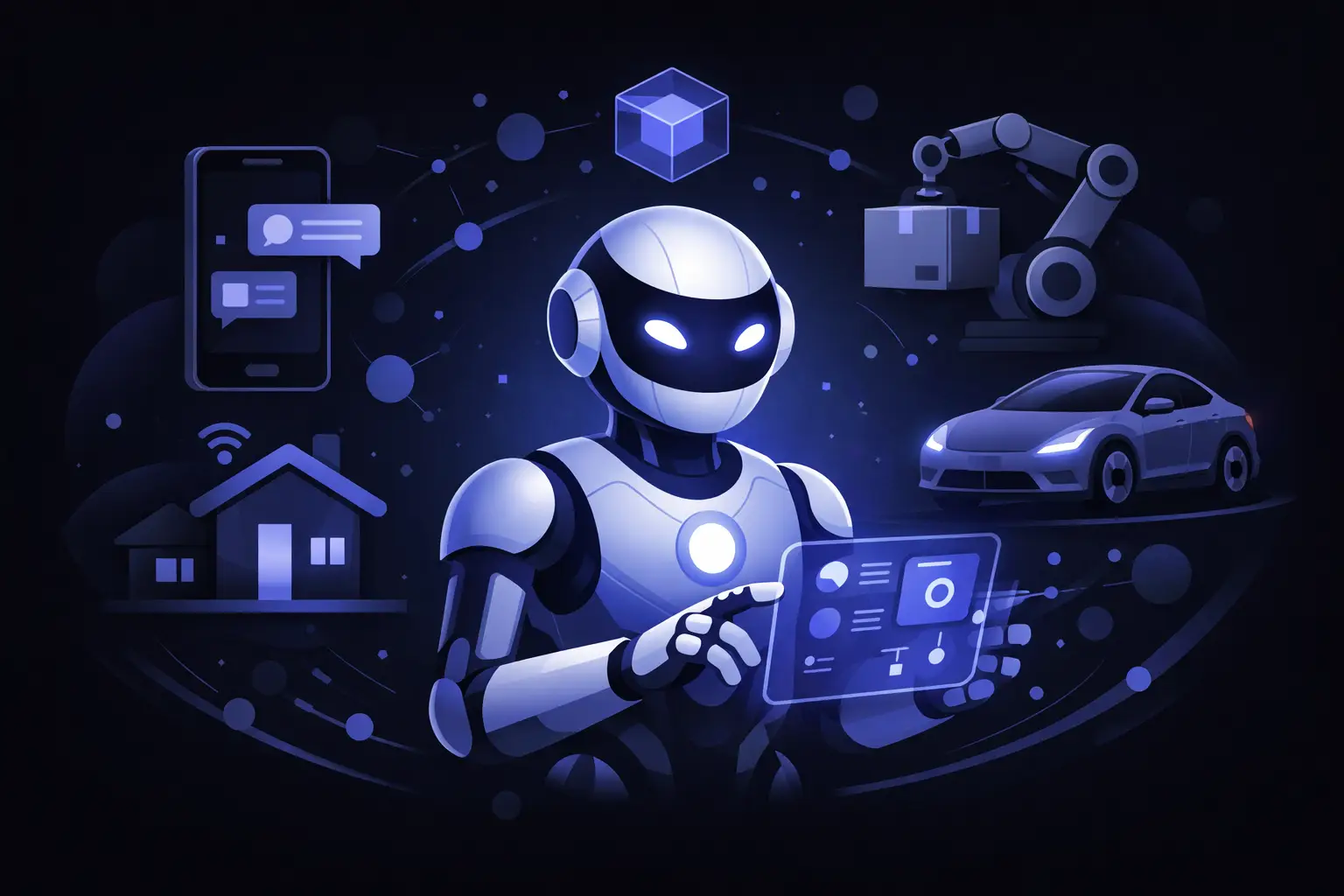
Most founders do not need another AI demo. They need a system that can handle real work without creating new operational risk. That is the real frame for the future of ai agents: not smarter chat windows, but software workers that can take action inside products, back offices, and customer workflows while staying reliable enough to trust.
The gap between prototype and production is where most agent projects fail. A polished demo can look impressive in a sales call, then fall apart when it hits inconsistent data, unclear permissions, edge cases, or real customer behavior. If you are building for a startup or growth-stage company, the future is less about asking what agents could do in theory and more about what they can do repeatedly, safely, and at a cost structure that makes sense.
The future of AI agents will be operational, not theatrical
A lot of the market still treats agents like magic. Give them tools, let them reason, and expect them to run entire business functions on autopilot. That makes for good headlines, but weak delivery.
In practice, the next phase belongs to narrower, better-scoped agents. These systems will not replace an entire team. They will own specific slices of work such as triaging support tickets, preparing sales research, reconciling internal data, drafting claims workflows, or coordinating actions across APIs. The companies that win here will not be the ones with the most ambitious prompt. They will be the ones with the cleanest workflow design, strongest guardrails, and clearest definition of success.
That shift matters because it changes how you build. You stop treating the model as the product and start treating it as one component inside a broader production system. Memory, authentication, retries, observability, human review, tool access, and audit trails become first-class concerns. That is where commercial value actually gets created.
What will define the future of AI agents
The future of ai agents will be shaped by execution constraints more than model benchmarks. Better models help, but they do not remove the hard parts. Founders and product leaders should pay attention to five forces that will matter far more than another leaderboard update.
Agents will move from conversation to action
Right now, many teams are still building chat-based interfaces because they are easy to ship. But users do not buy chat for its own sake. They buy outcomes.
The stronger pattern is action-oriented design. Instead of asking users to manage a long conversation, the agent should complete a job with visible status, clear inputs, and an obvious handoff if something breaks. That could mean filing a ticket, updating a CRM record, generating a report, or orchestrating a multi-step workflow across internal systems. Conversation still has a place, but mostly as a control layer around execution.
Reliability will beat novelty
There is a simple reason many AI features never get adopted after launch: users learn they cannot fully trust them. One bad output in a high-stakes workflow can kill retention.
The next generation of successful agent products will be built around reliability targets. That means constrained tool use, clear failure states, deterministic checks where possible, and logging that lets teams understand why the system behaved the way it did. A flashy autonomous agent that fails 20 percent of the time is usually less valuable than a more limited one that succeeds 95 percent of the time.
Specialized agents will outperform general ones
The broad dream is a universal agent that can do everything. The commercial reality is different. The most useful agents will be domain-specific and tightly integrated with the systems around them.
An insurance claims agent, a recruiting coordination agent, and a DevOps incident agent each need different logic, permissions, evaluation methods, and escalation paths. General capability is useful underneath, but product advantage will come from vertical understanding and workflow fit. For startups, this is good news. You do not need to beat the largest labs at general intelligence. You need to solve a painful problem inside a repeatable operating context.
Human oversight will stay in the loop
There is a lot of loose talk about fully autonomous operations. In some low-risk environments, that will happen. In most real businesses, human oversight will remain part of the system.
That is not a weakness. It is often the right design choice. Good agent architecture puts humans at the points where judgment, accountability, or exception handling matter most. Review queues, approval steps, editable drafts, and confidence thresholds are not temporary patches. In many use cases, they are permanent features of a production-ready product.
The moat will be systems, not prompts
Prompt engineering still matters, but it is not a durable advantage on its own. The stronger moat comes from infrastructure and execution quality: proprietary workflow data, deep integrations, evaluation pipelines, user feedback loops, and operational knowledge about where failures happen.
This is one reason the future of ai agents favors teams that know how to ship and maintain software, not just experiment with models. A real agent product needs architecture decisions, product judgment, and instrumentation from day one.
Where founders should be careful
The biggest mistake is trying to hand an agent an entire business process before you understand the failure modes. That usually leads to brittle systems, confused users, and engineering teams spending more time babysitting the feature than improving it.
Another common issue is weak cost discipline. Agent workflows can become expensive fast when they chain multiple model calls, invoke retrieval systems, and run repeated retries. If the unit economics do not work at moderate volume, the feature may look exciting in testing and painful in production.
Security is another place where optimism gets punished. Agents with write access to internal systems, customer records, or financial workflows need strict permission boundaries. Tool use should be intentional, observable, and limited by role. If an agent can take action, you need to know exactly what it can touch and how that access is controlled.
Then there is evaluation. Many teams still judge agents by vibe. That is not enough. If you cannot define what good performance looks like, measure failure types, and compare changes over time, you are guessing. Production AI needs the same seriousness as any other core system.
What a strong agent product looks like
A good agent product starts with a narrow, expensive problem. Not a broad statement like improve operations, but a specific job where time, accuracy, or responsiveness clearly matter. From there, the workflow gets broken into pieces: what the agent should decide, what tools it should use, where deterministic software should handle the task, and when a human should step in.
The interface matters too. Strong products do not hide uncertainty. They show progress, sources, confidence, and next actions in a way users can understand. When the system fails, the user should know what happened and what to do next.
Under the hood, the architecture should support tracing, retries, evaluation, and change control. This is not glamorous work, but it is what turns an AI feature into a durable product. Teams that skip it usually end up rebuilding after launch.
For startups, the right move is often to begin with an agent-assisted workflow rather than a fully autonomous one. Let the system save time first. Then expand scope as you learn where trust is justified. That path is slower in the short term, but faster if your goal is adoption instead of a demo.
A practical view of the next 3 years
Over the next few years, expect agents to become a standard layer in software products, especially in internal ops, customer support, sales execution, compliance-heavy workflows, and developer tooling. The category will mature in a familiar way. Early excitement will give way to stricter buyer expectations. Teams will stop asking whether a product has AI and start asking whether the agent actually reduces headcount pressure, response times, error rates, or time-to-completion.
That shift will be healthy. It will reward builders who care about production standards and expose teams that are still selling prototypes dressed up as platforms.
If you are a founder, the opportunity is real, but the bar is rising. The future of ai agents belongs to products that are scoped tightly, integrated deeply, and measured ruthlessly. Not because that sounds sophisticated, but because that is what holds up when customers depend on it.
The companies that get this right will not win by promising an autonomous future. They will win by shipping one reliable piece of useful autonomy at a time.

About the author
Usama Moin
Technical Consultant & Product Builder
Usama Moin has 11+ years of experience building revenue-focused web, mobile, and AI products for startups and scale-ups. He works hands-on across product strategy, full-stack engineering, React Native, and production AI systems.