June 10, 2026 • 8 min read· Updated June 11, 2026
How to Productionize AI Prototype Fast
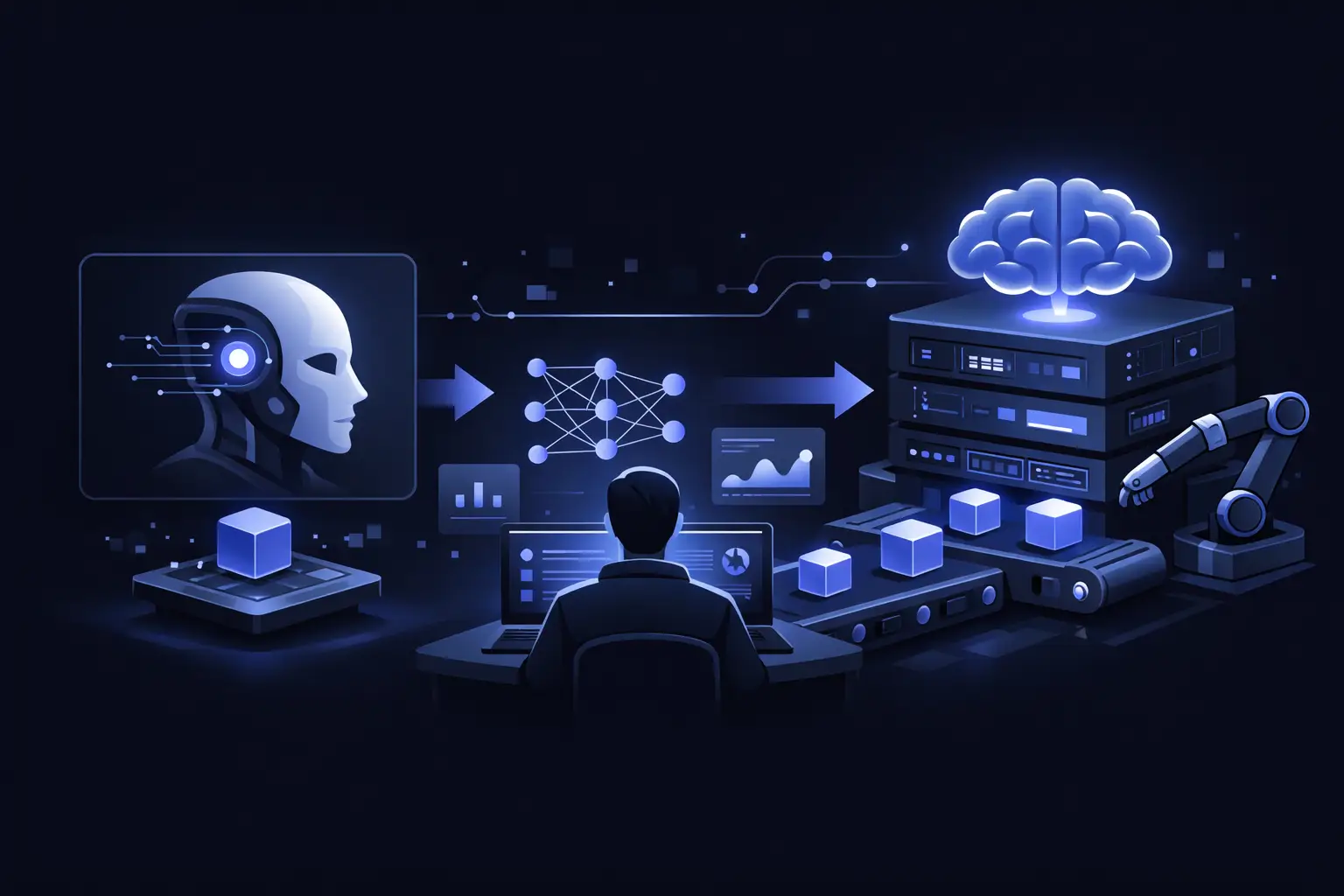
Most AI prototypes look impressive for 10 minutes. They answer a few prompts well, impress a founder or investor, and then fall apart the moment real users, messy inputs, latency, cost, and compliance show up. That gap is exactly where teams get stuck asking how to productionize AI prototype work without turning a quick win into a long rebuild.
The hard part is not getting a model to produce something useful once. The hard part is making that behavior reliable enough to support a product, a workflow, or a revenue path. If you are a founder or product lead, the real question is not whether the prototype works. It is whether the system around it is ready for production.
What productionizing an AI prototype actually means
A prototype proves possibility. A production system proves repeatability.
That distinction matters because most AI prototypes are held together by prompt tweaks, manual testing, and assumptions that do not survive contact with customers. The model may be good enough, but the surrounding system usually is not. Inputs are too loose, outputs are not validated, observability is missing, and nobody has defined what success looks like beyond, "it seems good."
When you productionize an AI prototype, you are turning a demo into an operating system for a real product. That means clear success criteria, stable data flows, error handling, logging, access control, cost controls, evaluation pipelines, and a fallback plan for when the model behaves badly. It also means making choices that fit your stage. A seed-stage startup does not need enterprise-grade ceremony, but it does need production-grade thinking.
Start with the business case, not the model
If you want to know how to productionize AI prototype efforts without wasting months, start by narrowing the job. What exact task is the AI performing, for whom, and what business outcome improves if it works consistently?
This is where a lot of teams drift. They begin with a general-purpose assistant or a broad automation idea, then try to engineer their way toward value. That usually creates sprawl. A better approach is to define one narrow production use case with measurable impact. Maybe it cuts manual review time by 60 percent. Maybe it drafts sales notes with an acceptable edit rate. Maybe it routes support tickets with higher accuracy than a rules-based system.
The tighter the use case, the easier it is to evaluate, monitor, and improve. You do not productionize AI by making it more magical. You productionize it by making the job smaller and the expectations clearer.
Lock down your inputs and outputs
A prototype can tolerate vague inputs. Production cannot.
If users can type anything, upload anything, or trigger the system from half a dozen places, you need a contract between your application and the model. Define the accepted input shape, clean the data before inference, and normalize what the system sees. If context comes from your own data, make sure retrieval is deterministic enough to debug. If prompts depend on user state, version that logic instead of editing it ad hoc.
The same goes for outputs. Do not let the model return free-form responses if your product needs structured actions downstream. Use schemas, validation layers, confidence thresholds, and rejection paths. If the output fails validation, the system should retry, degrade gracefully, or route to a human. Silent failure is how AI features lose trust fast.
Build evaluations before you scale usage
The fastest way to create technical debt in AI is to ship without evals. You cannot improve what you cannot measure, and you definitely cannot safely refactor prompts, models, or retrieval pipelines if you have no baseline.
Create a test set that reflects real production cases, not only the happy path from your demo. Include edge cases, ambiguous requests, low-quality inputs, and adversarial examples if misuse is plausible. Then define what good looks like. Depending on the use case, that might be factual accuracy, classification precision, task completion rate, latency, cost per task, or human acceptance rate.
This does not need to be academic. It needs to be useful. For early-stage teams, a lightweight eval harness with representative examples and a repeatable scoring process is often enough to make better shipping decisions. The goal is to stop arguing from anecdotes.
Design for failure from day one
Every production AI system fails. The question is whether it fails expensively, invisibly, or safely.
That means you need fallbacks. If the model times out, what happens? If retrieval returns weak context, do you answer anyway or ask a clarifying question? If the confidence score is low, does the user see a warning, a limited response, or a human review queue? These are product decisions as much as technical ones.
This is also where many teams overbuild. Not every workflow needs a human in the loop, and not every error deserves a complex orchestration layer. But every production system needs an explicit failure strategy. If your current design assumes the model will usually do the right thing, you do not have a production design yet.
The architecture should match the risk
There is no single right stack for how to productionize AI prototype systems. It depends on the problem, the volume, the compliance constraints, and the level of reliability required.
For some products, a model API behind a clean application layer is enough. For others, you need retrieval, async jobs, queues, caching, model routing, and strict audit trails. The mistake is choosing architecture based on what is trendy rather than what the product actually needs.
A useful rule is to keep the AI-specific layer modular. Your app should not be tightly coupled to one provider, one prompt shape, or one orchestration framework unless there is a strong reason. Abstract the interface, version your prompts and policies, and keep business logic outside the model call where possible. That gives you room to swap models, control costs, and debug issues without rewriting the product.
Security, privacy, and compliance are product requirements
If your prototype touched synthetic data in a sandbox, production will be different. Real customers bring sensitive inputs, account-level permissions, retention concerns, and expectations around data handling.
Before launch, decide what data can be sent to a model provider, what must stay internal, how long logs are retained, and who can inspect traces. If the system can take actions on behalf of users, enforce permissions at the application layer instead of trusting the model to behave. If you operate in a regulated environment, involve compliance and legal early enough to shape the design.
This is not bureaucracy. It is risk control. Founders usually feel this only after a customer security review blocks a deal or a team realizes too late that logs contain sensitive material.
Observability is not optional
When an AI feature underperforms, teams often lack the basic evidence to understand why. They cannot see the exact input, retrieved context, prompt version, model used, output quality, latency, or failure mode across sessions.
Production systems need that visibility. Log enough to trace behavior without creating unnecessary exposure. Track token usage, latency by step, validation failures, fallback rates, and human correction patterns. Monitor quality trends after prompt or model changes. If users abandon the feature, figure out whether the issue is trust, speed, cost, or output quality.
Without observability, every bug turns into guesswork. With it, you can improve the system like an engineering product instead of treating it like a black box.
Roll out in stages
A controlled rollout beats a big launch for almost every AI feature.
Start with internal users or a narrow customer segment. Watch what breaks. Review low-confidence cases. Measure cost under actual usage patterns. You will usually find that the prototype was tested against ideal behavior, while production reveals strange input combinations, repeated retries, and usage spikes that change the economics.
This staged approach also helps with stakeholder alignment. Founders want speed, but they also need confidence that the feature will not create support issues or damage trust. A phased release gives you signal without betting the whole product on a system that is still maturing.
What founders usually underestimate
The model is rarely the main blocker. The blockers are usually unclear ownership, weak product boundaries, no eval discipline, and a codebase that mixes prompts, business logic, and infrastructure concerns into one hard-to-change mess.
That is why productionizing AI is not just an ML task. It is product engineering, backend architecture, operations, and decision-making. Teams that treat it like a prompt-engineering problem tend to keep patching the demo. Teams that treat it like a software delivery problem ship something they can actually maintain.
If you are moving from proof of concept to product, the best next step is usually not adding more AI. It is tightening the scope, defining the reliability bar, and building the system around the model like you expect customers to depend on it.
That shift is what turns an AI prototype from an internal experiment into something worth putting in front of users. And once you make that shift, progress gets a lot less mysterious.

About the author
Usama Moin
Technical Consultant & Product Builder
Usama Moin has 11+ years of experience building revenue-focused web, mobile, and AI products for startups and scale-ups. He works hands-on across product strategy, full-stack engineering, React Native, and production AI systems.