September 26, 2026 • 8 min read· Updated September 27, 2026
How to Scope MVP Features Without Losing Weeks
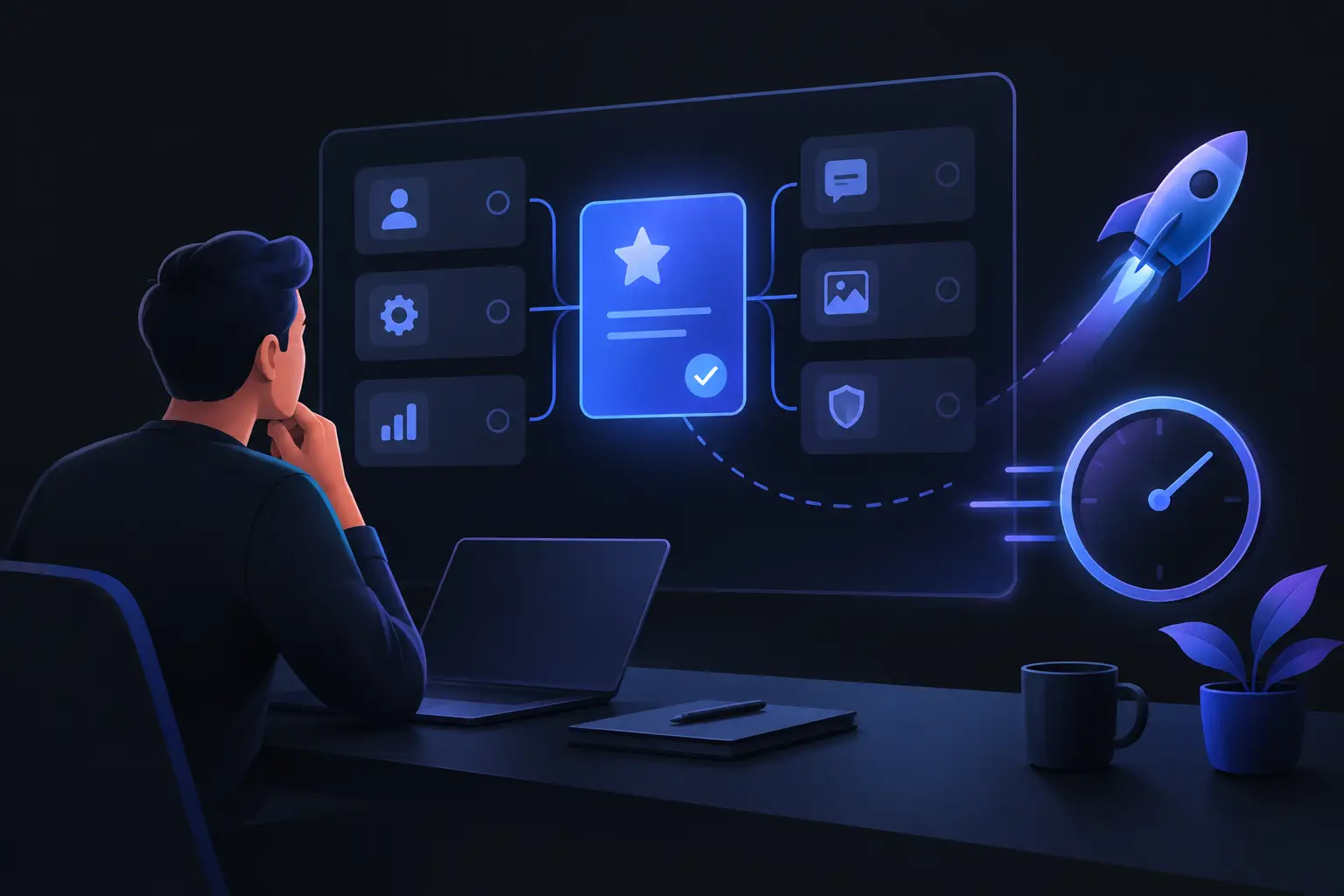
Most MVPs do not fail because the team cannot build them. They fail because the scope is a disguised version of the full product. If you are figuring out how to scope MVP features, the real job is not making a shorter backlog. It is defining the smallest production-ready product that can test a meaningful business assumption.
That distinction matters. A clickable prototype can test whether people understand an idea. An MVP should test whether they will take the behavior that makes the business work: create, pay, invite, book, upload, return, or complete a workflow. Everything else is secondary until that behavior is proven.
Start With the Risk, Not the Feature List
Founders often begin with a list of screens and capabilities: onboarding, profiles, notifications, dashboards, payments, analytics, admin tools, integrations, AI features, and settings. That list may describe the eventual product. It does not tell you what to build first.
Start by naming the biggest risk standing between the company and traction. For an early B2B SaaS product, the risk may be whether a team will trust the product with a recurring operational task. For a consumer marketplace, it may be whether supply can fulfill demand reliably. For an AI product, it may be whether output quality is useful enough that a customer will repeat the workflow.
Write the assumption in plain language: “Operations managers will upload invoices every week if the product reduces reconciliation time by at least half.” Now the scope discussion has a standard. A feature belongs in the MVP only if it is necessary to test, deliver, or measure that assumption.
This prevents a common mistake: prioritizing features based on how impressive they sound in a demo. Investors, early customers, and internal stakeholders may all have opinions. The MVP still needs one clear learning objective.
Define One Complete User Journey
The MVP should make one core job possible from start to finish. Not partially possible. Not possible if a founder manually fixes five gaps in the background. The user should be able to reach a real outcome.
For example, a simple B2B reporting product might have this core journey: a user signs up, connects or uploads data, sees a useful report, and shares it with a teammate. That is a complete loop. It can validate whether the output is valuable and whether collaboration creates pull.
A full product may eventually need role-based permissions, multiple data sources, custom dashboards, scheduled exports, billing controls, audit logs, and integrations. Those are valid roadmap items. They are not automatically MVP features.
When scoping, describe the journey as a sequence of user actions and system responses. If you cannot explain the journey in a few sentences, the scope is probably still too broad. If the journey has several equally important outcomes, choose one and defer the others.
Build the happy path first, then protect it
A happy path is not an excuse to ship something fragile. It means you optimize the first release for the most common, highest-value use case rather than every edge case.
If users upload CSV files, support the format your target customers actually use. Do not build a universal import engine on day one. If the product sends notifications, start with one channel that reaches users reliably. Do not ship email, SMS, push, Slack, and Teams because each could be useful later.
The production bar still applies. Authentication, data handling, basic monitoring, error states, backups where appropriate, and a deployable architecture are not optional because they are invisible. A fast MVP that cannot be trusted by its first users creates misleading feedback and expensive rework.
Use a Feature Filter That Forces Trade-Offs
Every proposed feature should answer four questions:
- Does it directly help the user complete the core journey?
- Does it reduce the biggest product, market, or technical risk?
- Can the team validate its value without building a broader system around it?
- What breaks if this feature is handled manually for the first cohort?
The last question is especially useful. Manual work is often acceptable in an MVP when it happens behind the scenes and does not damage the customer experience. A founder can manually review submissions, configure an account, enrich data, or provide concierge support while learning what should be automated.
Manual work is not acceptable when it creates a false product promise, exposes sensitive data carelessly, or becomes the only reason the workflow works. The goal is not to hide operational gaps forever. It is to avoid automating assumptions before you have evidence.
A practical way to classify scope is to separate features into three buckets: core, support, and later. Core features make the key user outcome possible. Support features make the first release usable, safe, and measurable. Later features improve flexibility, polish, or scale after the central behavior is validated.
Be strict with the “later” bucket. A feature can be valuable and still be wrong for version one.
Scope Technical Decisions for Reversibility
Feature scope and technical scope are linked. A product can look small on paper while quietly requiring complex architecture, multiple third-party integrations, real-time synchronization, or difficult AI reliability work.
Choose an implementation approach that supports the current experiment without boxing the product into a corner. That usually means a clear data model, a maintainable codebase, reliable environments, and a small number of well-understood services. It does not mean building infrastructure for millions of users before you have ten active customers.
For example, do not introduce microservices because the roadmap might become large. Start with a well-structured application when that is sufficient. But do not hard-code core business logic across screens just to move faster. The first choice is overengineering. The second is technical debt disguised as speed.
The right decision depends on the product. A regulated workflow, financial data, healthcare information, or enterprise security requirement changes what “minimum” means. So does a product whose core value depends on low latency, high-volume processing, or reliable agent behavior. MVP scope should be lean, not careless.
Turn Scope Into Acceptance Criteria
A feature title is not scope. “Build onboarding” leaves too much open to interpretation. “Build onboarding for a single workspace owner using email sign-in, company name, and one required use-case question” is buildable.
For each core feature, define the trigger, the user action, the expected result, and the failure behavior. Keep it concise, but make it testable. The team should know what done means before implementation begins.
This is where many projects recover weeks of time. Ambiguous requirements create design churn, engineering assumptions, QA surprises, and stakeholder debates at the end of a sprint. Clear acceptance criteria surface those decisions early, when they are cheap to change.
Also define what the MVP will not do. Explicit exclusions are a delivery tool. If custom reporting, multi-language support, advanced permissions, or native mobile apps are out of scope, write it down. Otherwise, they tend to reappear as “small additions” during build.
Measure the Behavior That Validates the MVP
If you cannot name the signal that would make the MVP successful, you are not ready to finalize scope. Downloads and signups are rarely enough. You need a behavior tied to the value proposition.
For a workflow product, that might be the percentage of users who complete the workflow again within seven days. For a marketplace, it may be successful transactions with acceptable fulfillment quality. For an AI assistant, it may be the rate at which users accept output without heavy editing and return for another task.
Instrument the core journey from the beginning. Track where users enter, where they stop, how long the key action takes, and whether they return. Pair the numbers with direct customer conversations. Analytics tells you what happened; conversations tell you why.
Do not confuse early requests with validated demand. A customer asking for a feature may be useful input, but repeated behavior is stronger evidence. Build the next feature when it removes a proven obstacle in the journey, not because it was the loudest request in a call.
Run a Scope Review Before Development Starts
Before the team writes production code, review the MVP through three lenses: business value, delivery risk, and operating reality. Ask whether the release can acquire users, deliver the promised outcome, and be supported by the people available.
If the scope requires multiple critical integrations, several user types, complex approval flows, and custom reporting, it is likely more than an MVP. Split it. Launch with a narrower customer segment, a single integration, or one role with a focused job to be done.
The best MVP scope creates momentum without pretending the hard parts do not exist. Ship the smallest version that earns real feedback, protects customer trust, and gives you a credible foundation for the next decision. That is how a product moves from an idea to evidence instead of from a backlog to a delayed launch.

About the author
Usama Moin
Technical Consultant & Product Builder
Usama Moin has 11+ years of experience building revenue-focused web, mobile, and AI products for startups and scale-ups. He works hands-on across product strategy, full-stack engineering, React Native, and production AI systems.