September 20, 2026 • 8 min read· Updated September 21, 2026
How to Validate App Architecture Before You Build
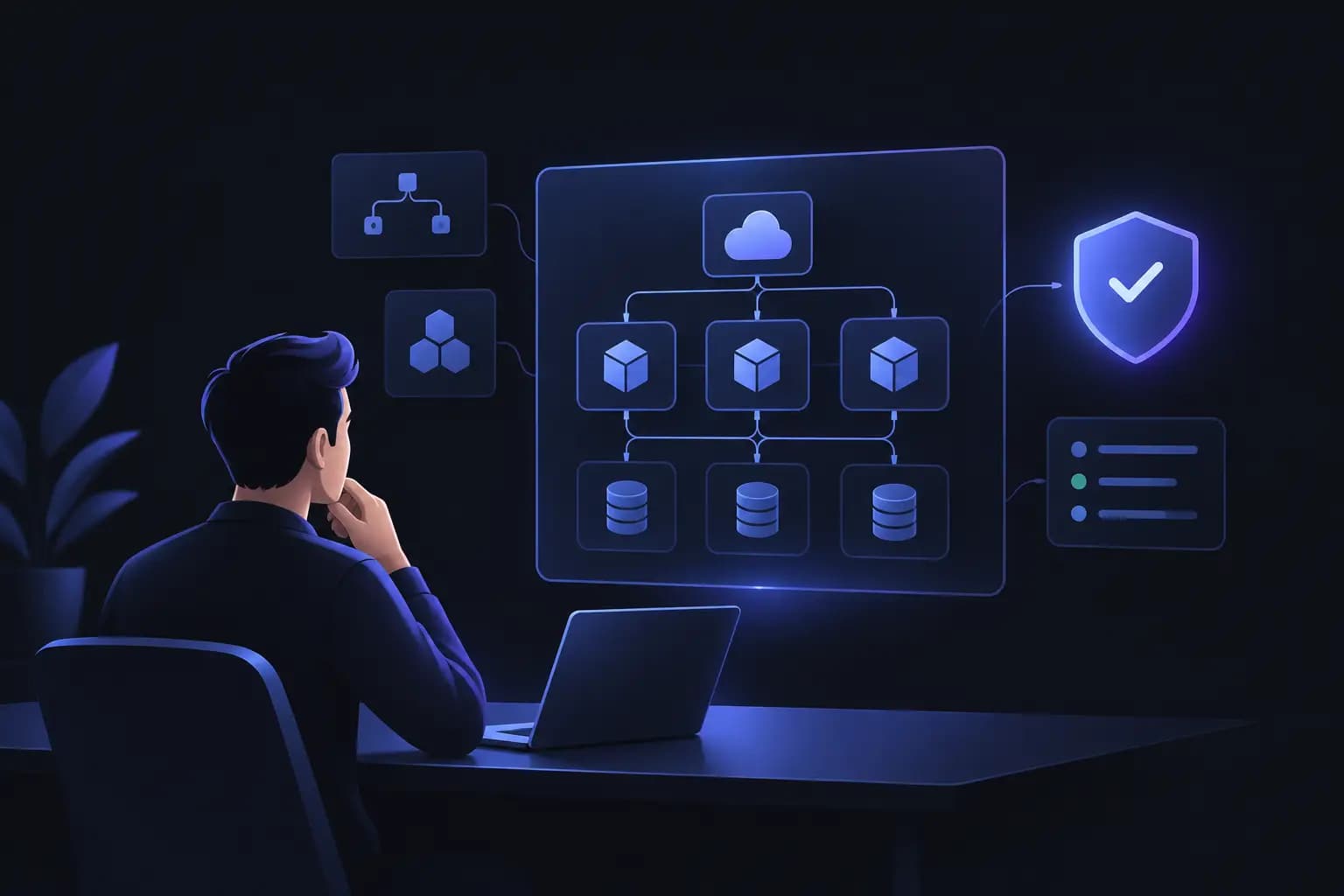
A prototype can prove that an idea looks real. It does not prove the product can survive real users, payment failures, third-party API limits, a growing team, or an urgent production fix at 11 PM. Knowing how to validate app architecture before your build accelerates is how founders avoid spending months polishing a system that needs to be rebuilt after launch.
Architecture validation is not a request for a 60-page diagram or a premature microservices program. It is a focused effort to test the decisions that are expensive to reverse: where state lives, how data moves, which systems you depend on, how you secure sensitive actions, and what happens when demand grows. The goal is simple: ship quickly without creating a product your next engineering team cannot safely own.
Start With Business Risk, Not a Tech Stack
The wrong starting question is, “Should we use React Native, Node.js, PostgreSQL, or serverless?” Those are implementation choices. The better question is, “What could stop this product from delivering its commercial value?”
For a consumer marketplace, risk may center on location accuracy, payments, trust and safety, and peak traffic during a campaign. For B2B SaaS, it may be tenant isolation, permissions, auditability, enterprise integrations, and data exports. For an AI product, the critical issues may be model latency, unpredictable usage costs, evaluation quality, human review, and what happens when an upstream model provider fails.
Write down the product’s core workflows before reviewing components. A useful architecture validation session starts with five to eight flows that must work in production, such as onboarding, account creation, checkout, file processing, notification delivery, reporting, or a user-facing AI action. Then identify what each flow needs from the system: speed, consistency, privacy, recoverability, and observability.
This approach stops teams from optimizing for theoretical scale while ignoring a broken billing workflow or an integration that cannot handle retries.
How to Validate App Architecture Against Real Workflows
Take each critical workflow and trace it from the user action to the final outcome. Do not stop at the happy path. Ask what happens when the network drops, a user taps twice, a webhook arrives late, a database write succeeds but a notification fails, or a provider returns an incomplete response.
For example, a subscription upgrade looks simple in a product spec. In production, it can involve a client request, your API, a payment processor, webhooks, entitlement updates, email delivery, analytics events, and customer support visibility. If these steps are not designed to be idempotent and traceable, users can be charged without receiving access or receive access without payment confirmation.
Architecture is validated when the system has a credible answer to these operational questions. That does not mean every edge case needs code on day one. It means you know which failures are acceptable, which require recovery, and where that recovery happens.
A senior technical review should produce decisions, not just observations. For every material risk, assign one of three outcomes: solve before launch, defer with a defined limit, or remove the dependency altogether. “We will deal with it later” is not a decision unless the trigger for dealing with it is explicit.
Test Assumptions With Small Spikes
A technical spike is a narrow, time-boxed experiment used to answer a high-risk question before it becomes embedded in the product. It is one of the fastest ways to validate architecture without overbuilding.
If your product depends on real-time collaboration, build a small proof that tests concurrent edits, reconnection behavior, and conflict handling. If video processing is central, process representative files and measure cost, turnaround time, and failure rates. If an AI agent needs access to customer data, test permission boundaries, tool failures, prompt injection exposure, and the quality of its output against realistic inputs.
The key word is representative. Testing a single clean payload from your laptop proves very little. Use the largest likely files, slower network conditions, messy customer data, duplicate requests, and provider errors. You are not trying to simulate every future scenario. You are trying to expose the assumptions that could force a redesign.
Spikes should end with a decision record: what was tested, what happened, what limits were observed, and what design choice follows. This documentation is lightweight, but it prevents the team from revisiting the same debate six weeks later with no shared context.
Validate the Data Model Before the UI Gets Expensive
Founders often see data modeling as an internal engineering concern. It is not. A weak data model becomes a product constraint that shows up as missing reports, unreliable permissions, impossible migrations, and slow feature delivery.
Review the entities that represent the business: users, organizations, subscriptions, orders, content, approvals, messages, or whatever creates value in your product. Then test the relationships that will matter later. Can one user belong to multiple organizations? Can a record change ownership? Is history required? Can a customer delete data? Are different users allowed to see different fields within the same account?
Multi-tenant SaaS products deserve extra scrutiny here. Tenant isolation must be enforced at the data-access layer, not only hidden in the interface. Role-based access also needs more precision than “admin” and “member” if your sales motion will eventually include larger customers, delegated teams, or compliance requirements.
Avoid designing for every hypothetical enterprise requirement. But do not choose shortcuts that make normal growth painful. A single-user model may be right for a focused MVP. It is a bad shortcut if your first paying customers will invite colleagues within weeks.
Pressure-Test Scale, Security, and Reliability
Early-stage products rarely need internet-scale infrastructure. They do need clear limits and a path to address them. The question is not whether your first architecture can handle 100 million users. The question is whether you know what breaks at 1,000, 10,000, or 100,000 users, depending on the product.
Start with the likely bottleneck. It may be database queries, a third-party API quota, synchronous image processing, long-running AI jobs, or a mobile client that loads too much data at once. Add basic measurements early: request duration, error rate, queue depth, provider failures, and the business events that matter, such as completed checkouts or successful document processing.
Security validation should be equally practical. Confirm authentication flows, session handling, authorization checks, secrets management, encryption needs, input validation, rate limits, and backup recovery. If your app handles payments, health data, financial information, or customer documents, define what is stored, who can access it, and how access is logged.
A security checklist alone is not enough. Look for dangerous paths through the actual application. Can a user change an ID in a request and access another customer’s data? Can an AI tool call actions it should only suggest? Can a deleted account still access cached content? Those are production failures, not abstract risks.
Check Whether the Team Can Own It
An architecture can be technically impressive and commercially wrong if it requires a specialized team to operate. This is a common failure mode when a startup adopts distributed services, complex event systems, or multiple cloud products before there is a real need.
Validate maintainability through ordinary delivery work. Can a new engineer run the project locally? Can they understand the deployment path? Are environments consistent? Is the codebase organized around clear domains? Can you trace a user-reported error from the interface to logs and underlying data?
For most MVPs, a well-structured modular monolith is the right default. It gives a team one deployable system, faster iteration, simpler debugging, and fewer moving parts. Separate services when a proven boundary demands it: materially different scaling needs, strong security isolation, independent release cycles, or a workload that cannot safely run alongside the core application.
The trade-off is real. A simpler system may need restructuring later. But premature complexity slows feature delivery now, makes incidents harder to diagnose, and creates a dependency on the people who originally assembled it. Build for the next stage of the business, not the fantasy version of the company five years out.
Use a Decision Gate Before Full Build
Before committing to full implementation, bring product, engineering, and operations into one short decision gate. Review the critical workflows, spike results, data model, external dependencies, security controls, operating metrics, and known limits. The output should be a concise architecture plan with named owners and open risks.
If a risk remains unresolved, make the choice visible. You may still launch with it, especially when speed matters, but define the guardrail. Perhaps the beta is capped at a certain number of accounts, uploads are limited by size, an integration is manual for the first cohort, or a high-cost AI action is restricted until unit economics are proven.
That is disciplined startup execution. You are not waiting for certainty. You are buying down the risks that would make speed expensive.
The best time to challenge an architecture is when changing it costs a few days, not after customers depend on it. Build the smallest production-ready foundation that supports your actual business model, measure it under real conditions, and keep every major technical choice easy to explain to the team that will own it next.

About the author
Usama Moin
Technical Consultant & Product Builder
Usama Moin has 11+ years of experience building revenue-focused web, mobile, and AI products for startups and scale-ups. He works hands-on across product strategy, full-stack engineering, React Native, and production AI systems.