September 14, 2026 • 9 min read· Updated September 15, 2026
Multi Tenant SaaS Design Guide for Founders
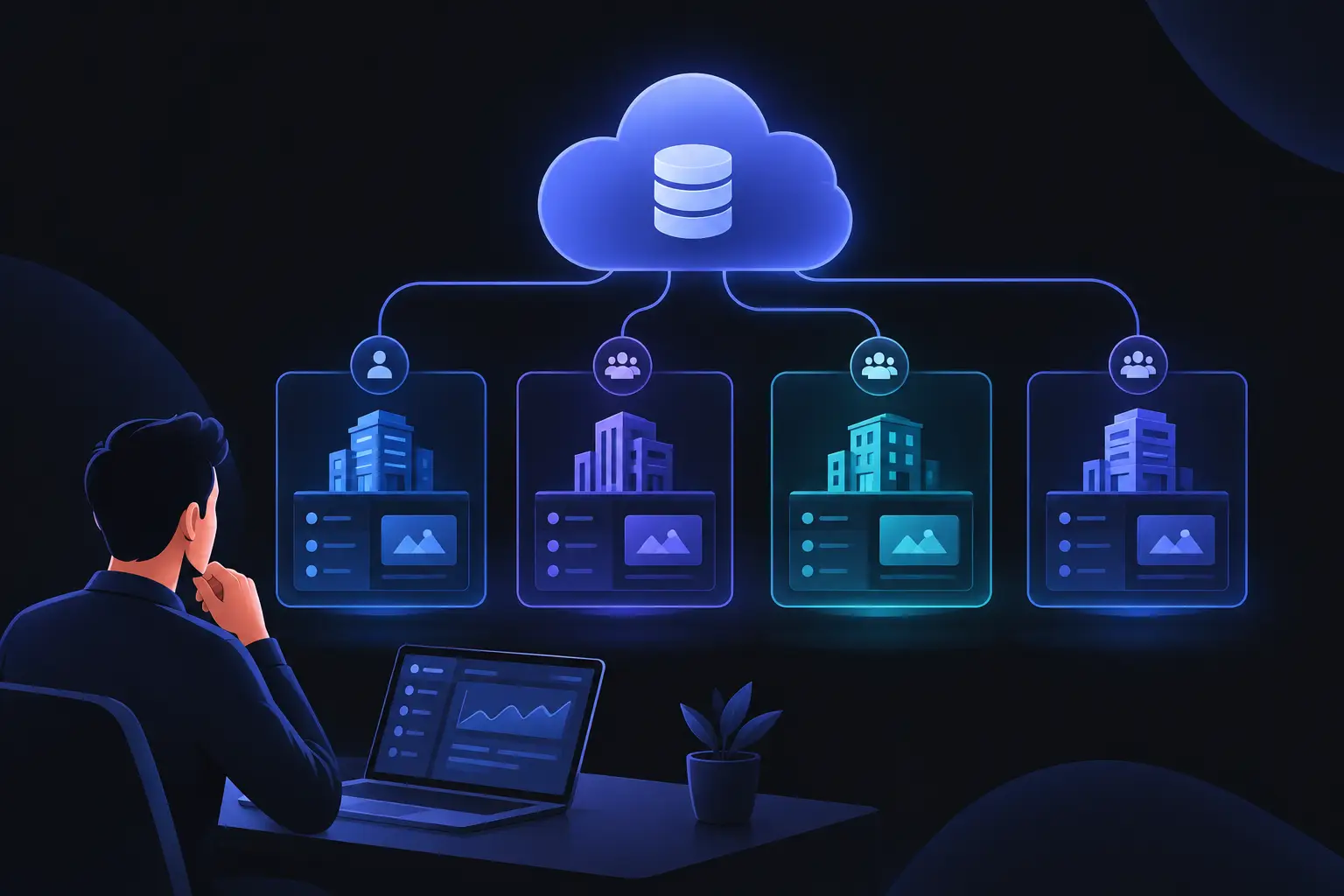
A multi tenant SaaS design guide is not a database tutorial. It is a set of product and architecture decisions that determine whether your SaaS can sell to larger customers, protect customer data, and evolve without forcing a rewrite six months after launch.
Founders often start with a single customer workflow, then add organizations, invites, roles, and account-level settings after the product gains traction. That sequence is understandable, but it creates expensive cleanup work when tenant boundaries were never designed into the core model. The goal is not enterprise theater. The goal is to ship a product that can support real customers without turning every new feature into an authorization risk.
Start With the Tenant Boundary
A tenant is usually a customer organization: a company, workspace, clinic, agency, or team that owns users, data, settings, and subscription entitlements. But “usually” matters. A marketplace may need both buyer organizations and seller organizations. A platform for franchises may have locations under a parent account. An agency tool may allow one user to switch among several client workspaces.
Define the tenant boundary in product terms before selecting infrastructure. Ask who owns the data, who can invite users, who pays, who can export data, and what happens when an employee leaves. If the answers vary by customer type, model those differences deliberately rather than hiding them in conditional logic scattered across the application.
For most early-stage SaaS products, the basic relationship is straightforward: users belong to one or more organizations, and every customer-owned record belongs to an organization. That organization ID should be a first-class field, not an afterthought added to a few tables.
A practical model commonly includes `users`, `organizations`, and `memberships`. The membership record connects a user to an organization and stores their role. Product data such as projects, documents, tasks, messages, and integrations should carry an organization ID directly or inherit it through a clearly enforced parent relationship.
Choose Isolation Based on Risk, Not Fashion
The biggest multi-tenant architecture decision is how strongly to isolate customer data. There is no universal winner. The right choice depends on the sensitivity of the data, compliance commitments, customer scale, operational maturity, and how much customization each account requires.
Shared Database, Shared Schema
In this model, every tenant uses the same tables and each record is scoped by an organization ID. It is usually the fastest option for an MVP because migrations are simple, analytics can work across tenants, and infrastructure stays manageable.
The downside is obvious: a missing tenant filter can expose data. You reduce that risk by enforcing scope in more than one layer. The API should resolve the active organization from a trusted session or token, not a client-provided ID. Database queries should apply organization filtering by default. Where your stack supports it, row-level security adds another guardrail at the database layer.
This approach works well for many B2B SaaS products, provided the engineering team treats tenant scoping as security-critical code. A shared schema is not inherently unsafe. Casual enforcement is unsafe.
Shared Database, Separate Schemas
Separate schemas give each tenant a logical partition inside one database. This can make certain isolation and export requirements easier to reason about, but it increases migration, reporting, and operational complexity. Hundreds or thousands of schemas can become a tax on every deployment.
Use this model when customer-level customization or contractual isolation requirements justify the overhead. Do not choose it simply because it sounds more enterprise-ready.
Separate Database Per Tenant
A database per tenant offers the strongest isolation and can simplify deletion, restoration, region-specific hosting, and high-value customer requirements. It also creates real work: provisioning, migrations, connection management, observability, backups, and cross-tenant reporting all become more complex.
This model is often a better fit for regulated workflows, large enterprise accounts, or products with unusually high data volumes per customer. A sensible path for many startups is to begin with shared infrastructure and build an abstraction that allows selected accounts to move to dedicated resources later.
Make Authorization a Product Capability
Authentication answers, “Who is this user?” Authorization answers, “What can this user do inside this tenant?” Confusing the two is a common source of SaaS security failures.
Start with a small role model that maps to actual customer workflows. For example, an owner can manage the organization and sensitive settings, an admin can manage members and operational data, a member can do day-to-day work, and a viewer has limited access. Keep it understandable. A complicated permissions matrix before you have evidence of need will slow product delivery and confuse users.
That said, roles alone may not be enough. Some actions depend on resource ownership, plan entitlements, approval states, or department boundaries. Build authorization checks around capabilities, not UI visibility. Hiding a button does not secure an endpoint. Every server action must verify the user’s membership, role or capability, tenant context, and access to the specific resource.
Treat service accounts, API keys, webhooks, and background jobs as part of the same authorization system. A nightly job that queries records without tenant scope can cause the same damage as a poorly protected dashboard endpoint.
Design the Request Path to Prevent Leaks
A secure request has a predictable path: identify the user, establish the active organization, verify membership, load only scoped data, then enforce action-level permission. Make that path boring and reusable.
The dangerous alternative is letting each route handler interpret tenant context independently. One developer reads an organization ID from the URL, another uses a header, and a third trusts a request body field. That inconsistency creates bypasses as the codebase grows.
Centralize tenant resolution in middleware or a service layer. Then expose scoped repositories or query helpers that require an organization context. For example, `getProject(projectId)` is easy to misuse. `getProjectForOrganization(organizationId, projectId)` makes the tenant boundary visible in the call itself.
Test the negative cases. A user from Organization A should not be able to retrieve, update, delete, export, or trigger workflow actions on a record from Organization B, even if they guess a valid identifier. This should be part of automated test coverage, not a manual QA hope.
Separate Tenant Data From Platform Data
Not every record belongs to a tenant. Platform-level records may include internal administrators, feature definitions, audit policies, global templates, system configuration, and support tools. Keep this distinction explicit.
Mixing platform data and customer data in the same access patterns creates escalation risks. Internal support access should be deliberate, logged, and time-bound where possible. A support tool that silently impersonates customers may feel convenient during a launch, but it becomes a trust problem when the product serves serious businesses.
Audit logs deserve early attention. At a minimum, capture who performed a sensitive action, which tenant they acted within, what changed, when it happened, and the source of the action. You do not need a massive compliance program to benefit from being able to explain why a record changed.
Treat Entitlements as Data, Not Feature Flags in Code
Multi-tenant SaaS products often need account-level capabilities: usage limits, modules, add-ons, beta access, or integration availability. Hardcoding these checks across the frontend and backend works briefly, then becomes difficult to control.
Create an entitlement layer tied to the organization. The application can ask whether an organization has access to a capability or has reached a defined usage threshold. The answer should be enforced server-side, with the frontend reflecting the same state for a clear user experience.
This matters beyond monetization. Entitlements support controlled rollouts, customer-specific migrations, pilot programs, and operational switches when a third-party integration fails. The key is to avoid turning every customer exception into a branch in core business logic.
Build for Tenant Lifecycle Events
Tenants change. Companies merge, employees leave, owners transfer accounts, customers request exports, and organizations close. Design for these events before they arrive as support emergencies.
Your system needs clear rules for member removal, ownership transfer, organization deletion, retention periods, and data export. It also needs a plan for accidental deletion. Soft deletes can help, but only if the application consistently excludes deleted records and the restoration flow is tested.
Background processing needs special care. Queue messages should include tenant context, workers should validate it, and logs should retain enough context to diagnose failures without dumping sensitive customer data. This is where prototypes frequently break under production load: the web request is scoped correctly, but the asynchronous job is not.
Measure the Architecture Before It Becomes a Bottleneck
You cannot scale what you cannot attribute. Tag logs, metrics, traces, storage usage, and job activity with a tenant identifier where appropriate. That lets you identify a noisy tenant, investigate a failed integration, and understand whether one account is driving disproportionate load.
Be careful with cardinality in observability tools. Attaching every tenant ID to every metric can become expensive or unusable at scale. Use tenant identifiers heavily in logs and traces, while reserving aggregate metrics for operational dashboards. The implementation details depend on your tooling, but the principle holds: tenant-aware operations are part of multi-tenant design.
Build the Simplest Model You Can Defend
The right first version is rarely the most elaborate one. For many founders, that means a shared database, explicit organization IDs, centralized authorization, server-enforced entitlements, tenant-scoped background jobs, and tests designed to catch cross-tenant access.
That foundation is production-ready because it addresses the failure modes that damage trust and slow sales. Add dedicated databases, advanced custom roles, or complex hierarchy models when customer requirements and product evidence justify them.
If a multi-tenant decision is unclear, write down the customer scenario it must support and the failure you are trying to prevent. The best architecture is not the one with the most moving parts. It is the one your team can ship, audit, and evolve while customers depend on it.

About the author
Usama Moin
Technical Consultant & Product Builder
Usama Moin has 11+ years of experience building revenue-focused web, mobile, and AI products for startups and scale-ups. He works hands-on across product strategy, full-stack engineering, React Native, and production AI systems.