September 6, 2026 • 9 min read· Updated September 7, 2026
Startup Incident Response Guide for Founders
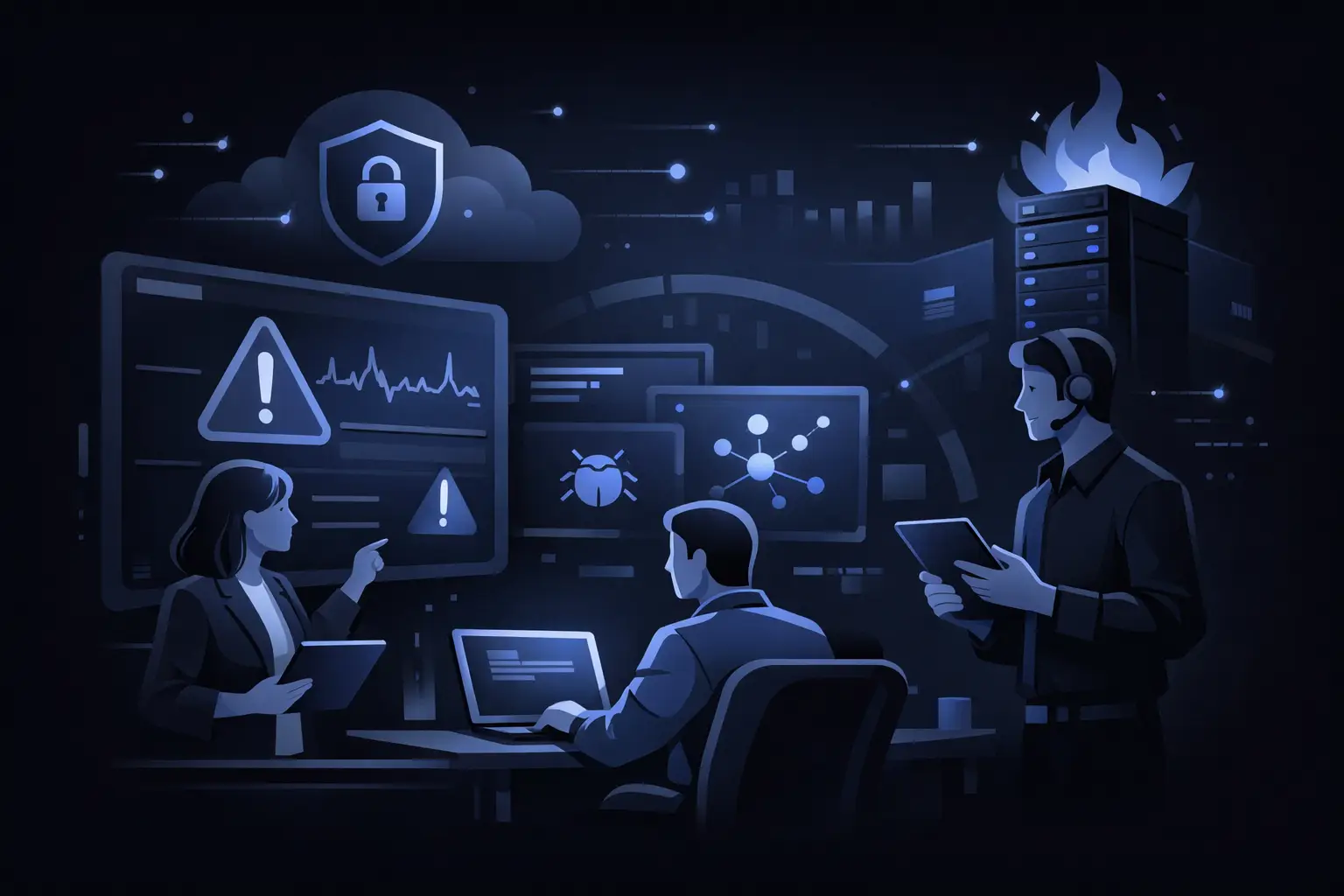
Your payment flow fails at 10:14 a.m. Support tickets arrive before engineering has identified the cause. A key customer posts about the issue publicly. This is when a startup incident response guide stops being operational paperwork and becomes a direct test of leadership, product quality, and customer trust.
For an early-stage company, an incident is rarely just an infrastructure problem. It can interrupt revenue, damage a launch, expose a security weakness, or pull a small team away from the work that keeps the business moving. The goal is not to build enterprise bureaucracy. The goal is to create a calm, repeatable way to make good decisions under pressure.
What counts as an incident at a startup?
An incident is an unplanned event that materially harms users, revenue, security, or the team's ability to operate. A minor visual bug that affects a handful of users can wait for normal triage. A broken login flow, corrupted customer data, exposed API key, unavailable API, or failed subscription renewal cannot.
The definition should reflect your stage and risk profile. A consumer MVP may treat a 30-minute outage as serious but acceptable if customer data remains safe. A B2B SaaS product supporting regulated customers may need immediate escalation for a much narrower set of failures. The principle is simple: classify incidents by customer and business impact, not by how technically interesting they are.
Use three practical levels. A Severity 1 incident means critical user journeys, sensitive data, or a large share of revenue are at risk. Severity 2 means a meaningful feature is degraded, with a workaround available. Severity 3 covers lower-impact defects that should be tracked and scheduled but do not require an emergency response.
Avoid creating five or six severity levels at this stage. If your team cannot consistently distinguish them during an outage, the system adds friction without improving decisions.
Build the startup incident response guide before the outage
A useful response process fits on one page and is accessible when the primary systems are unavailable. It should name who can declare an incident, who leads the response, where the team communicates, who updates customers, and when executives or founders get involved.
The biggest early-stage failure is assuming the most senior engineer should do everything. They often end up debugging, answering Slack messages, updating support, and deciding whether to roll back a deployment at the same time. That slows recovery and creates avoidable confusion.
Assign clear roles, even if one person temporarily holds more than one role:
- The incident commander owns prioritization, coordination, and the decision to close the incident.
- The technical lead investigates, coordinates mitigation, and validates recovery.
- The communications owner keeps support, leadership, and affected customers informed.
- The scribe records timestamps, decisions, changes, and open questions.
These are roles, not titles. A founder can be the communications owner. A senior contractor can lead technical investigation if they know the system. What matters is that everyone knows who is deciding, who is fixing, and who is communicating.
Your guide should also include a short service map. Document the user-facing journeys that generate revenue or carry the highest risk, then note the systems behind them: frontend, API, database, authentication provider, payment processor, queues, cloud infrastructure, and third-party dependencies. You do not need a perfect architecture diagram. You need enough visibility to avoid guessing where a failure might be hiding.
The first 30 minutes: contain the damage
During the first 30 minutes, the team's job is not to find the perfect root cause. It is to reduce customer impact, preserve evidence, and establish a shared view of reality.
Start by declaring the incident in a dedicated channel or call. State the time, observed impact, severity, incident commander, and next update time. A message such as “Sev 1: checkout failures reported across web and mobile since 10:14 a.m. Alex is incident commander. Next internal update at 10:35 a.m.” is more useful than a stream of speculative messages.
Then verify the impact. Check error rates, uptime signals, logs, payment events, user reports, and recent deployments. Separate confirmed facts from hypotheses. “The API error rate rose after deployment” is a fact. “The new cache configuration caused it” is a hypothesis until tested.
Containment may be as simple as rolling back a release, disabling a feature flag, switching traffic away from a failing service, pausing a job, or using a manual operational workaround. Rollback is often the right move, even when the team wants to fix forward. A fast rollback protects users and creates space for careful investigation.
There are trade-offs. Rolling back a database migration may be unsafe. Disabling a feature may break an important workflow for one customer segment. In those cases, the incident commander needs an explicit risk decision: what causes less harm over the next hour, not what produces the cleanest architecture.
Do not make uncontrolled production changes. Record every command, configuration change, and deploy. Otherwise, recovery can become harder to validate, and the later review becomes a reconstruction exercise based on memory.
Communicate like a company customers can trust
Silence creates its own incident. Customers usually tolerate a problem better than uncertainty, especially when the affected workflow is tied to money, access, or data.
Your first external update does not need a diagnosis. It needs accuracy. Confirm that you are aware of the issue, describe the customer-facing impact, state what users should do if there is a workaround, and commit to the next update time. Do not promise a resolution time unless you have evidence for it.
For a small outage, direct communication to affected customers may be enough. For broad service degradation, use a public status channel if you have one and keep support aligned with the same language. Give support a short approved response so they are not forced to improvise technical explanations.
Internally, update on a predictable cadence. The cadence matters more than long messages. A two-sentence update every 20 or 30 minutes keeps stakeholders informed without pulling the technical team into constant interruption.
Be candid after recovery. If customer data was affected, say what happened, what was restored, and what follow-up is underway. Trying to soften a material failure with vague language may protect the team for a day, but it erodes trust when customers compare notes.
Recovery is not complete when the dashboard turns green
A service can appear healthy while background jobs are failing, webhook events are queued, or customers are still locked out. Before closing an incident, validate the full user journey that was affected.
If checkout failed, run a real transaction in the production path where appropriate, confirm payment events are being processed, and identify whether failed attempts need customer follow-up. If login failed, test new and existing accounts, mobile and web clients, and the authentication provider's callback flow. If a queue stopped processing, verify the backlog is draining at a safe rate and that retries are not creating duplicate actions.
This is where production-ready engineering shows up. Monitoring should cover the customer experience, not only server health. A database can be online while your product is unusable.
Once the immediate issue is resolved, assign an owner to reconcile the blast radius. Identify affected users, failed transactions, missing records, delayed notifications, or manual work required to make customers whole. The incident is not truly closed while a hidden operational tail is still creating customer harm.
Run a blameless review that leads to changes
Schedule the review while the details are fresh, usually within a few business days. Blameless does not mean consequence-free or vague. It means the team examines how the system, process, tooling, and decisions allowed a failure to reach customers rather than reducing the conversation to who made a mistake.
A strong review answers four questions: What happened? Why did existing controls fail to prevent or detect it? What made recovery slower or harder? What specific changes will reduce recurrence or impact?
Write a timeline using evidence from alerts, deploy records, logs, and incident notes. Then separate root causes from contributing factors. A bad deployment may be the trigger, but missing automated tests, unclear ownership, no rollback procedure, weak alerts, and an undocumented dependency may all have expanded the impact.
Keep corrective actions concrete. “Improve monitoring” is not an action. “Alert when checkout success rate drops below the agreed threshold for five minutes, with a runbook linked in the alert” is an action. Every item needs an owner and a due date. If the item is not important enough to schedule, do not pretend it is a lesson learned.
Make incident readiness part of shipping
The most effective teams do not treat incident response as a document created after a painful outage. They build it into delivery. Before releasing a meaningful change, ask what can fail, how it will be detected, whether it can be rolled back, who owns the dependency, and how customers would be affected.
For a startup, this does not require a large reliability team. It requires basic production discipline: meaningful logs, error tracking, backups that are actually tested, access controls, deployment history, feature flags where they make sense, and a named owner for critical systems. Add depth as your customer base and operational risk grow.
If your product was assembled quickly, inherited from a previous team, or pushed live before its infrastructure was ready, an incident review can reveal where the real technical debt sits. That is useful information. The right response is not a rewrite by default. It is a prioritized plan that removes the failure modes most likely to hurt customers and revenue.
The next outage will test your product, but it will also show customers how your company operates when things go wrong. Build a response process your team can run at 2 a.m., then improve it every time reality exposes a gap.

About the author
Usama Moin
Technical Consultant & Product Builder
Usama Moin has 11+ years of experience building revenue-focused web, mobile, and AI products for startups and scale-ups. He works hands-on across product strategy, full-stack engineering, React Native, and production AI systems.