October 4, 2026 • 8 min read· Updated October 5, 2026
Serverless Versus Containers for SaaS Products
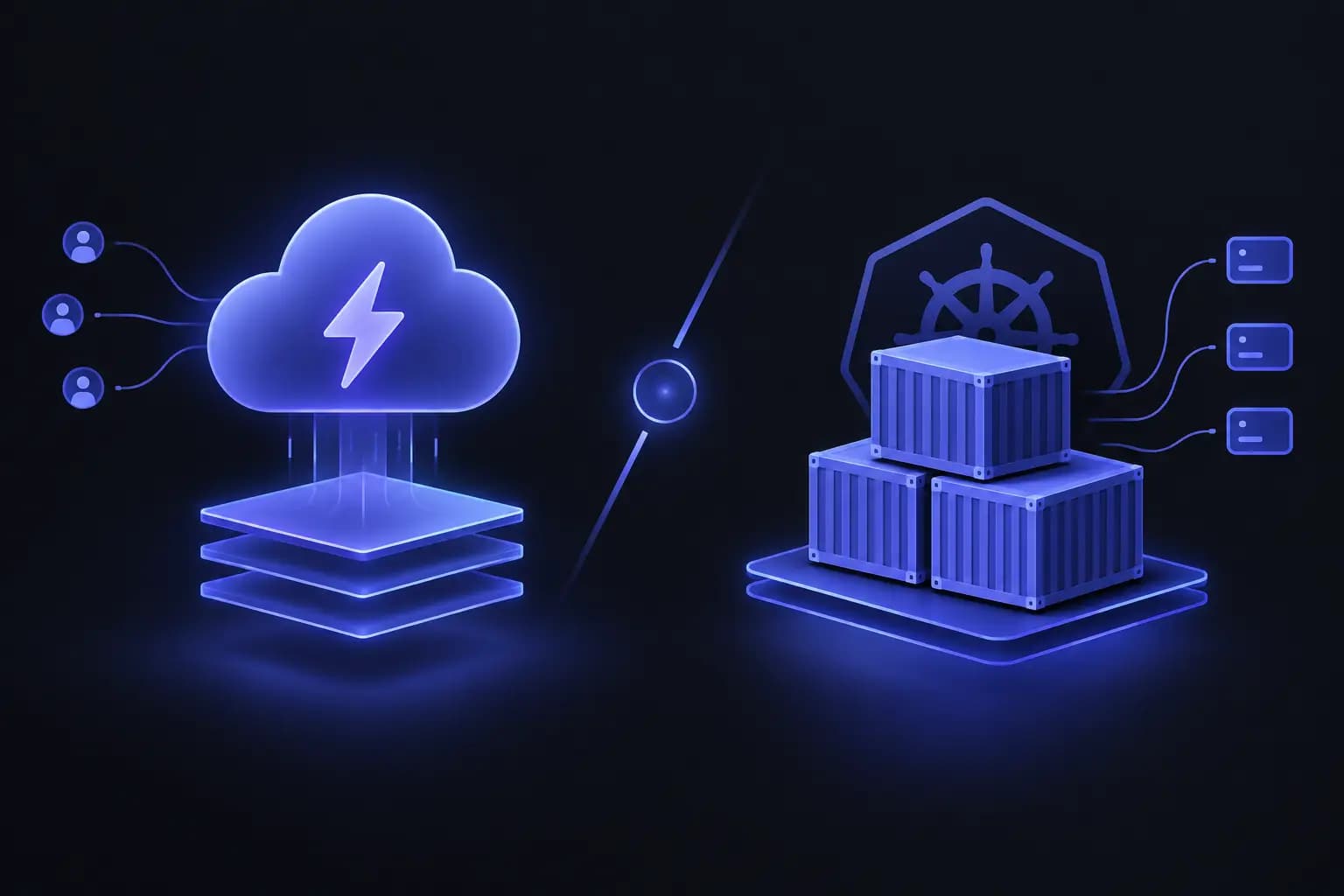
A founder rarely loses because they picked the wrong compute model on day one. They lose because an infrastructure decision made for a two-week prototype quietly becomes permanent, then starts slowing releases, inflating operational work, or failing under real customer behavior. The serverless versus containers SaaS decision is not about choosing the most modern stack. It is about choosing the operating model your product and team can support.
For an early SaaS product, both can be production-ready. Both can scale. Both can be expensive when implemented carelessly. The right choice depends on traffic patterns, workloads, release requirements, compliance needs, and whether your team needs to spend its time building product or managing infrastructure.
Serverless Versus Containers SaaS: The Real Decision
Serverless runs your code in response to events. A request comes in, a file is uploaded, a queue message arrives, a scheduled job fires, and the cloud platform executes the function. You pay for execution rather than for servers that sit idle. Common uses include APIs, webhooks, background jobs, image processing, notifications, and scheduled workflows.
Containers package an application and its dependencies into a portable runtime. You deploy that runtime to a managed container platform, a container orchestration system, or virtual machines. The application stays available as a running service, which gives you more control over networking, runtime behavior, concurrency, and resource allocation.
The superficial comparison is simple: serverless reduces infrastructure management, while containers offer more flexibility. The useful comparison goes further. Ask what happens when your SaaS has long-running jobs, persistent connections, uneven traffic, customer-specific integrations, a growing engineering team, and a release schedule that cannot tolerate surprises.
When Serverless Is the Better SaaS Choice
Serverless is often the fastest route from a validated product concept to a reliable first release. It works particularly well when usage is unpredictable, the product has clear event-driven workflows, and the team wants to avoid operating servers before there is a reason to do so.
A B2B SaaS might receive a burst of API traffic during business hours, then see very little activity overnight. With serverless, capacity can expand during the burst and fall away afterward. That is useful when early adoption is uneven and usage data is still immature. You do not need to provision for a traffic profile you have not earned yet.
It is also a strong fit for product features that are naturally asynchronous. Think of an AI feature that processes uploaded documents, a billing workflow triggered by a payment event, a nightly report, or a pipeline that sends data to a third-party CRM. These jobs can be decomposed into focused functions, placed on queues, retried safely, and observed independently.
The operational advantage is real. A small team can avoid patching host operating systems, planning server capacity, and keeping low-traffic services alive. That frees senior engineering time for authentication flows, product analytics, permissions, onboarding, and the problems customers actually notice.
Serverless is not automatically simpler, however. It shifts complexity rather than removing it. Distributed functions introduce more deployment units, more permissions, more observability needs, and more failure paths across queues, databases, and event handlers. If every feature becomes a new function with its own configuration, the system can become difficult to reason about.
Serverless works best when workloads are short and spiky
Serverless is usually a good fit when requests are short-lived, workloads can be broken into discrete events, and occasional cold-start latency will not damage the user experience. It is especially practical for internal tools, early-stage SaaS APIs, integration-heavy products, and background processing.
Be cautious if core product interactions require consistently low latency from the first request, tasks run for extended periods, or your application depends heavily on persistent in-memory state. There are ways to work around those constraints, but forcing them too early often creates a more complicated system than the product needs.
When Containers Are the Better SaaS Choice
Containers make more sense when your application behaves like a continuously running service. A typical full-stack SaaS with a web API, websocket connections, worker processes, and predictable background jobs can be cleanly operated as a small set of containerized services.
They are particularly useful for long-running processes. Real-time collaboration, streaming workloads, large data transformations, custom AI inference, browser automation, and workers that maintain connections to external systems often fit containers better than function runtimes. You have direct control over memory, CPU, process lifecycle, timeouts, and dependencies.
Containers also reduce friction when the team already has an application designed around a traditional server framework. A Node.js API, a Python service, or a worker process can run in a container with fewer architectural concessions. That can be valuable during a rescue project, when rewriting a stalled build into functions would add risk without creating business value.
For SaaS products with stable baseline usage, containers can provide more predictable performance. You keep a defined number of instances warm, control concurrency, and tune the runtime based on measured behavior. The trade-off is that someone must own deployment health, logs, monitoring, scaling policies, security updates, and incident response.
Containers are not a license to overbuild
A common early-stage mistake is deploying Kubernetes because the company expects to scale. Most startups do not need a full orchestration platform at MVP stage. Managed container services can deliver the operational control of containers without forcing the team to operate clusters.
Start with the smallest platform that meets your reliability and deployment needs. If a managed container service can run your API and workers cleanly, it is often the right middle ground. Build a product that earns complexity instead of borrowing it from a much larger company.
The Factors That Should Drive the Decision
The best architecture conversation starts with product behavior, not technology preferences. Four areas usually determine the answer.
First, look at workload duration and shape. Short, independent, event-driven tasks favor serverless. Long-running jobs, persistent connections, and services with complex runtime requirements favor containers.
Second, look at traffic. If demand is highly variable and idle periods are common, serverless can be efficient and operationally light. If there is steady traffic or strict latency requirements, containers may produce a more predictable experience.
Third, assess team ownership. A founder working with a lean product team should be skeptical of infrastructure that needs constant specialist attention. On the other hand, a team with strong platform engineering capability may benefit from container control and standardization across services.
Finally, consider the roadmap. Do not architect solely for the feature you are shipping this month, but do not design for a hypothetical million users either. Ask which customer commitments are likely within the next 12 months: enterprise integrations, audit requirements, real-time features, data-heavy workflows, regional deployment, or AI processing. Those are more meaningful signals than a vague goal to scale.
A Practical Architecture for Most Early SaaS Products
The strongest answer is often not serverless or containers. It is a deliberate combination.
Use a managed container service for the core API when you need a conventional application runtime, predictable request behavior, and straightforward local development. Use serverless functions or event-driven workers for webhooks, scheduled tasks, file processing, notifications, and bursty background work. Keep state in managed databases and object storage rather than in application instances.
This approach lets the product remain simple where simplicity matters while using elastic compute where it provides a clear advantage. It also creates a cleaner path for change. A background task that outgrows a function can move into a container worker. A rarely used endpoint can move into an event-driven function if that reduces operational overhead.
The key is to define boundaries early. Your API should not quietly become a job runner. Your background workers should not reach into the database without clear ownership rules. Your deployment pipeline should make every service and function observable, testable, and reversible. Production readiness comes from these controls, not from whether the code runs in a container image or a function runtime.
Avoid Architecture Debt Disguised as Speed
The fastest prototype is not always the fastest product to operate. Serverless can create hidden coupling through cloud-specific triggers and permissions. Containers can create unnecessary maintenance through oversized infrastructure and fragmented services. Both can become difficult when teams skip environment management, logging, alerting, database migration discipline, and rollback plans.
Before committing, run one representative workflow end to end. Include authentication, a database write, an external API call, a failed retry, monitoring, and deployment to a non-production environment. This exposes the operational reality of the design before it is embedded in the entire codebase.
For founders, the useful question is not which option is objectively better. It is which option lets your team ship the next meaningful release with confidence, observe what happens in production, and retain a clean path to evolve when customer behavior proves your assumptions wrong.

About the author
Usama Moin
Technical Consultant & Product Builder
Usama Moin has 11+ years of experience building revenue-focused web, mobile, and AI products for startups and scale-ups. He works hands-on across product strategy, full-stack engineering, React Native, and production AI systems.